Beijing walks a thin line as Hong Kong erupts at the worst possible time

Hong Kong (CNN)This week's violent protests in Hong Kong against a controversial extradition bill couldn't come at a worse time for China's stability-obsessed Communist Party and its leader, President Xi Jinping.
Facing a weakening economy, and with trade tensions with the United States at an all-time high, experts say Xi is under pressure to deliver on the enormous power he's amassed since coming to power in late 2012.
Tens of thousands of mostly young protestors took to the streets again on Wednesday, temporarily shutting down Hong Kong's Legislative Council and surrounding streets, and forcing a delay in the proposed reading of the bill.
At least 81 people were injured throughout the day, as an estimated 5,000 riot police fired rubber bullets and tear gas at protesters.
Experts say Beijing doesn't want to be seen to back down on the extradition law but can't afford to inflame matters with a serious crackdown. The dilemma has left the normally blunt Xi administration with a narrow line to walk to avoid escalating the Hong Kong crisis.
The Chinese government response Wednesday was defiant in both state media and official government statements.
"It is lawlessness that will hurt Hong Kong, not the proposed amendments to its fugitive law," an editorial in the state-run China Daily said.
But Willy Lam, an adjunct professor at the Chinese University of Hong Kong and a longtime analyst of Chinese politics, said the extradition crisis has no clear or easy solution for Beijing.
"A ferocious confrontation is shaping up between the will of the Hong Kong people and the Xi Jinping administration, (which is) determined to be the arbiter of things in Hong Kong," he said.

A protester returns a tear-gas canister fired by police during clashes outside the government headquarters in Hong Kong on Wednesday, June 12.

Rubber bullets, pepper spray and hand-thrown tear gas were used to push back protesters who had occupied the city's main thoroughfare and other roads near the government headquarters, Hong Kong Police Commissioner Steven Lo Wai-chung said.

Protesters run after police fired tear gas on Wednesday.

A policeman reacts to an umbrella that was thrown near the Legislative Council buildings. The Umbrella Movement in 2014 galvanized Hong Kong's youth and was mainly student-led. But this week, there are lawyers, business people and middle-aged people protesting for the first time.

Police officers fire tear gas during the demonstration.

Police officers use a water cannon on a protester near the government headquarters.

Protesters shield themselves against pepper spray used by police.

Police fire tear gas toward protesters outside the Legislative Council.

A protester reacts as she is grabbed by police during Wednesday's demonstration.

Police and protesters clash outside the Legislative Council buildings.

Protesters face off with police during Wednesday's rally.

A protester rests during the demonstration. Protesters began arriving the night before.
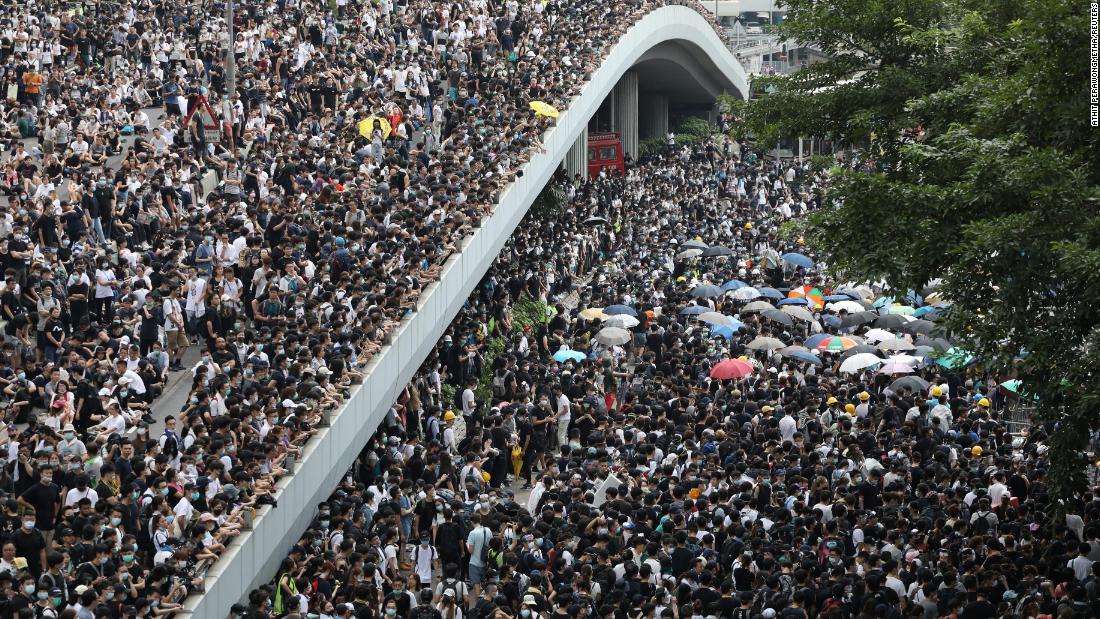
By Wednesday morning, tens of thousands of mainly young people had arrived in the area, blocking streets and bringing central Hong Kong to a standstill.

Pro-democracy lawmaker Roy Kwong chants slogans outside the Legislative Council on Wednesday.

Protesters block major roads near the Legislative Council and government headquarters. Hundreds of businesses, parents and teachers called for a boycott of work and school on Wednesday to show their opposition to the bill.

A demonstrator holds a sign during Wednesday's rally.

Up to 5,000 police in riot gear were deployed to guard the Legislative Council buildings.

Demonstrators occupy roads outside the Legislative Council on Monday, June 10. It was a continuation of protests that started the day before.

Police use pepper spray against protesters early on Monday. The protest was mostly peaceful during the day, but it turned violent overnight, with police trying to clear away protesters with pepper spray and batons.
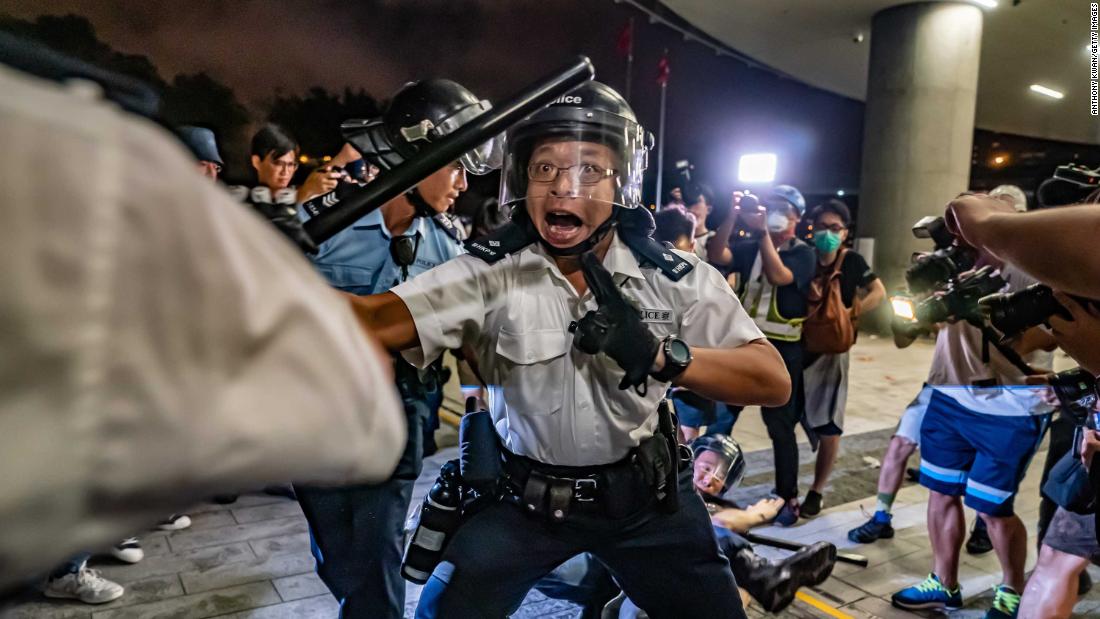
Police officers charge toward protesters during clashes on Monday.

A protester reacts as police and demonstrators clash on Monday.

Demonstrators occupy a major road outside the Legislative Council on Monday.

A police camera films the rally on Sunday, June 9.

Protesters hold pictures of Hong Kong Chief Executive Carrie Lam on Sunday.

A protester shouts next to police officers during the march on Sunday.

The extradition bill has caused political gridlock and outcry among the city's usually pro-conservative business community.
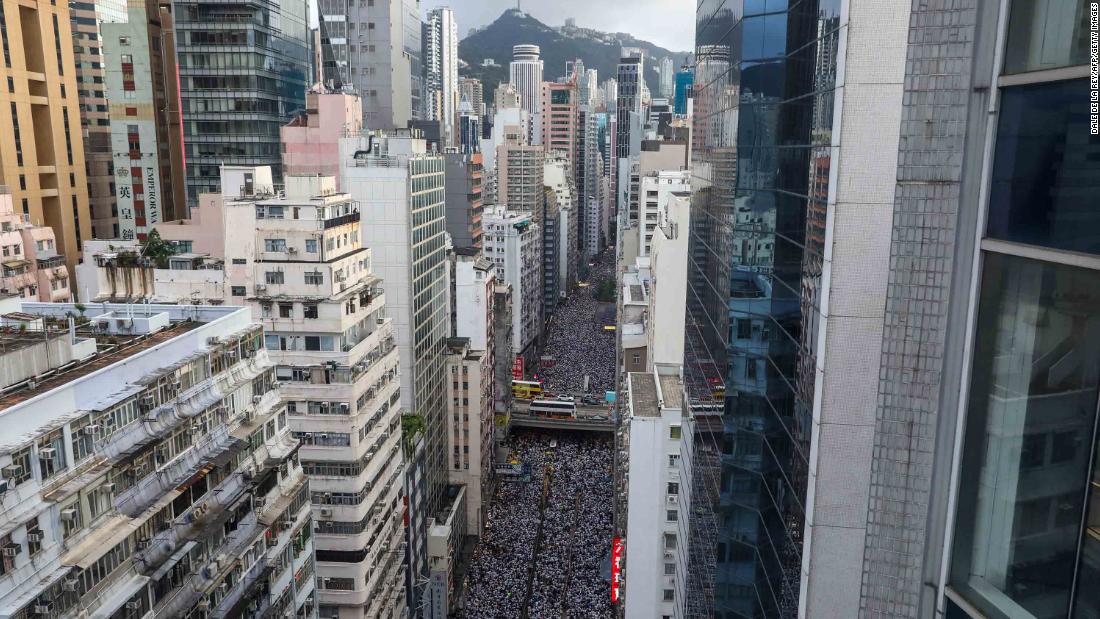
Protesters on Sunday waved placards and wore white -- the designated color of the rally. "Hong Kong, never give up!" some chanted.

Demonstrators hold signs during Sunday's protest.

A crowd fills a Hong Kong street on Sunday.
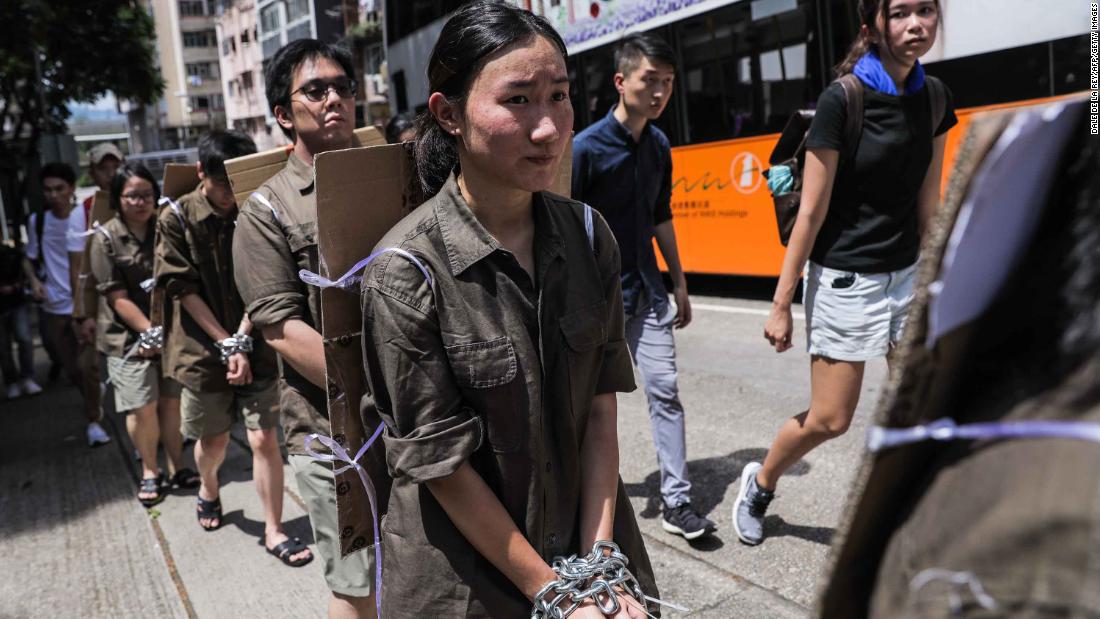
Students wear chains during a demonstration on Saturday, June 8.
Beijing stands by law
The protests were sparked by new laws, proposed by the pro-Beijing Hong Kong administration, which would allow fugitives to be extradited to mainland China from Hong Kong.
Many protesters say they are worried the laws could be used to send political activists and dissidents from the city to China to face harsher punishments.
Publicly, the Chinese government has offered its support to Hong Kong Chief Executive Carrie Lam in her attempts to pass the bill.
"The central government firmly supports the Hong Kong SAR government in advancing the amendment to the two ordinances," Chinese Foreign Ministry spokesman Geng Shuang said Wednesday.
But expert Lam said while the central government in Beijing couldn't be seen to back down, they would be wary of the possibility that ongoing protests could damage Hong Kong's business sector at a time of growing pressure on China's economy.
Hong Kong is allowed economic freedoms that are restricted to the rest of the country, which, tied with an unbiased court system left over from the UK colonial period, have led to many large Western businesses basing their lucrative China operations out of the city.
There is no end in sight to the trade war between the US and China after negotiations collapsed in early May and new tariffs were imposed by both sides on hundreds of billions of dollars of exports.
The Chinese government maintains it is not afraid of a trade war but there are already signs that the economy is continuing to slow. As more US businesses begin to look at investments outside of China, Hong Kong's role as the country's most economically liberal city is more important than ever.
"They need to give way to the fact that the Hong Kong economy will suffer tremendously, and hence the Chinese economy, if the protests continue," said Lam.
On Wednesday, all mentions and images of the protests were quickly censored on Chinese social media, including Weibo and WeChat, leaving citizens across the border in Shenzhen largely in the dark about the mass demonstrations happening just miles away.

'We have to let China know human rights have to be defended,' says Ai Weiwei03:41
Sensitive year for Beijing
In October, Beijing will celebrate the 70th anniversary of the founding of the People's Republic of China. It's a momentous occasion, that will mark the point at which the Chinese Communist Party surpasses that of the Soviet Union as the longest-ruling Communist Party in history. The Communist Party of the Soviet Union ruled that country from 1922 to 1991.
This year also marked the centenary of the May 4 movement, a 1919 student-led protest and the 30th anniversary of 1989 Tiananmen Square massacre, on June 4.
In order to ensure the year passes without controversy, high-profile activists have been quietly put under house arrest and internet censorship has been stepped up.
In this tightly-controlled atmosphere, mass public protests in one of the country's most famous cities are likely to perceived as an unwanted headache.
Failure to handle the protests would reflect "very poorly" on Xi, Lam said. "He has (already) been subjected to internal criticism by senior party members for failing to handle Donald Trump, for failing to handle the larger Cold War between China and the US."
Amid an atmosphere of deteriorating relations between China and the United States, Beijing has accused "foreign forces" of interfering in Hong Kong politics and helping to spark the protests.
"We resolutely oppose actions and words by any foreign forces to interfere in the legislative matters of the Hong Kong SAR," Geng, the spokesman, said on Monday.
Beijing has long feared a so-called color revolution in its territory, following a string of uprisings that swept through former Soviet states, such as Ukraine in the early 2000s, disposing of long-established rulers. These fears were reinvigorated by the Arab Spring protests and revolutions beginning in 2010.
An editorial published Wednesday in the state-owned Global Times tabloid appeared to accuse protesters of "collusion" with foreign powers.
"Hong Kong citizens need to recognize those forces who try to deceive and mislead them and use them to realize their own interests," the paper said.
Chinese officials have previously accused Western governments of being behind Hong Kong's democracy movement, and cautioned residents of the potential turmoil that would result in an overthrow of the status-quo.
CNN's Serenitie Wang contributed to this article.
Analysis by Ben Westcott and Steven Jiang, CNN >>


Comments
Post a Comment